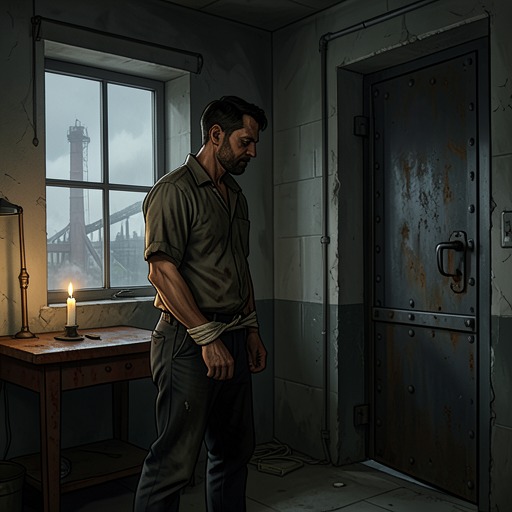
Five-O
A Man in FullFive-O is a Hawaiian inmate at Santa Rita whose jailhouse pragmatism becomes an unlikely source of guidance and companionship for Conrad Hensley. He teaches Conrad that a prisoner cannot remain invisible: survival depends on whether others see him as a player or a punk. Yet Five-O’s advice is not simply about force. His insistence on using the mouth, and his response to Conrad’s eventual confrontation with Rotto, connect verbal resistance with the courage to act. By the time the earthquake tears through the prison, Five-O has come to regard Conrad as a brother.
Identity and Life in the Cell
Five-O is introduced through the rough, improvised routines of jail life. In one scene, he uses sharpened guitar wire to tattoo a three-inch image of an AK-47 on Mutt’s chest, just below the joining point of the collarbones. Mutt complains about the pain; Five-O explains that he is trying to get the curve of the ammunition clip right, illustrating it with a small arc of his hand. The episode presents him as resourceful and familiar with the makeshift practices of the cell, while his attention to the weapon’s shape gives the tattoo a particular, studied detail.
After Mutt’s departure, Five-O takes the lower bunk and Conrad moves to the upper one. A deputy removes Conrad’s floor mattress and the bags containing Mutt’s belongings, leaving Conrad with a place to sleep at full length. Five-O’s own possessions give the cell a more specific human texture: a commuter mug, nail clipper, Ramen, Dr Pepper, two paperbacks, a small book of silhouettes, letters, writing supplies, a toothbrush, toothpaste, and a photograph of a smiling Hawaiian girl in a diner. His other effects include three disposable pens, a Salvation Army address book, shampoo, instant coffee, and two ice-cream cups repurposed as containers, one with a blackened lid pushed inside and plastic wrap stretched across its opening. These objects suggest a daily life organized around the small things an inmate can keep, use, or adapt.
A Cellmate and a Jailhouse Teacher
Five-O’s manner toward Conrad changes sharply once the two share a cell. He had previously glowered at the newcomer, but after Mutt leaves he begins talking to Conrad constantly. His need for company is so pronounced that Conrad wonders whether he could have endured even half a day in solitary confinement. The sudden friendliness does not erase Conrad’s caution: Five-O has some connection to Nuestra Familia, and Conrad does not yet know how far he can trust him. Still, Five-O offers practical instruction about how a new prisoner is expected to behave, and Conrad is grateful for the attention even when he would rather return to reading Epictetus.
The central lesson is that quietness cannot make a new fish invisible. Five-O warns that a prisoner must be either a player or a punk; if others decide he is a punk, they will eventually “grind” him. Conrad understands that word as being eaten up—bitten, chewed, swallowed, obliterated—and asks how someone becomes a player. Five-O’s code is stark, but it gives Conrad a vocabulary for the pressures of the pod: passivity is not a safe position when other inmates are watching for weakness.
His advice also includes using speech to avoid a fight. When Conrad later reminds him that he had recommended using the mouth rather than getting into a beef, Five-O recognizes that Conrad has put the lesson into practice. He laughs that the other man’s mouth proved even bigger than his own, affectionately calling him a motormouth. The exchange turns instruction into reciprocal recognition: Five-O’s lesson has mattered, but Conrad has applied it in a way that surprises and amuses his teacher.
Rotto, Pocahontas, and the Meaning of Resistance
Five-O reads the pod’s shifting alliances with a practical eye. After Vastly disrespects Rotto, he tells Conrad that Rotto will make somebody pay. The prediction follows the prison’s unstable pattern of negotiation: Rotto’s assurances about a future confrontation mean little because such bargains can be forgotten when the next pod time arrives. Five-O understands that a public humiliation may create a new danger even when the immediate standoff ends.
That danger becomes focused on Pocahontas. Five-O is distressed by Rotto’s attention to him and repeatedly insists that Pocahontas should have fought back. In Five-O’s view, the choice was not between fighting and safety: Rotto’s gang would treat him as a target either way, so he should at least have tried to break Rotto’s face. Conrad objects that Pocahontas is weak and skinny and that Rotto could kill him. Five-O answers that a beating would be preferable to what Rotto and his associates might otherwise do. His blunt advice grows from the same player-or-punk code he gave Conrad, but here its costs are more apparent: resistance may be dangerous, while refusing it may expose a prisoner to worse harm.
When Conrad confronts Rotto, Five-O later describes the scene as a reversal witnessed by the whole pod. He had expected the polite new fish to be overwhelmed; instead, Conrad used his words, acted from the heart, and beat Rotto. Five-O’s excitement makes the episode more than a victory report. He identifies the public change in how the pod sees Conrad: the newcomer who seemed likely to submit has shown that he can answer a challenge. Five-O’s pride also reveals the warmth beneath his rough counsel. His approval is not detached analysis; he speaks as though he had been in Conrad’s corner all along.
The Earthquake and the Parting
When the earthquake brings Santa Rita apart, Five-O and Conrad are together in their cell. Conrad calls to him and tries to get them beneath the bunks as the catwalk loosens. The lower bunk pitches, the structure collapses, and both men are thrown against the wall and buried in darkness beneath the wreckage. Conrad, trapped and struggling for air in the dust, reaches backward and finds flesh; Five-O answers in a faint, frantic voice and grips his leg. The scene strips away the prison’s ordinary hierarchy and leaves the two men dependent on one another in the rubble.
Afterward, their exchange makes the bond explicit. Five-O tells Conrad that he is his brother and says Conrad saved his life. Conrad extends a hand and wishes him luck; Five-O clasps it with both hands. He urges Conrad to leave, while saying that he will handle the people and the wrecked place himself. Conrad then goes off into the darkness. The evidence establishes Five-O’s decision to stay and Conrad’s departure, but does not provide a later account of Five-O’s fate.
Narrative Role
Five-O serves as both a guide to prison conduct and a counterpoint to Conrad’s inward search for Stoic teaching. While Conrad turns to Epictetus for principles about what can be controlled, Five-O teaches a more immediate social lesson: other inmates read silence and hesitation, and a prisoner’s choices alter how he is treated. Their perspectives do not simply cancel each other out. Five-O’s practical warnings help Conrad understand the material stakes of action, while Conrad’s conduct gives Five-O reason to revise his view of the new fish.
His arc is also carried by repeated changes in relationship: suspicion gives way to constant talk, instruction becomes mutual joking, and a cellmate becomes a brother in the aftermath of the collapse. Five-O’s voice is often comic and exuberant, but his concerns about Pocahontas and Rotto expose the violence beneath the pod’s everyday negotiations. At the end, his grasp of Conrad’s hands and his insistence that Conrad go make their separation feel personal rather than merely logistical. Five-O remains behind; the loyalty between them is the part of the prison that the earthquake does not erase.